Structured infrastructure
Permanent devices are connected through organized cabling wherever practical, reducing unnecessary wireless load.

A smart home depends on a network that can move data reliably between automation controllers, cameras, access points, entertainment systems and everyday devices.
Streaming, security, automation, remote management and work-from-home traffic all converge on the network. When the network is improvised, every connected system can feel unstable. A properly designed network provides structured cabling, organized switching, suitable routing and enough capacity for both current devices and future expansion.
Permanent devices are connected through organized cabling wherever practical, reducing unnecessary wireless load.
Network hardware can be selected and configured so high-bandwidth, critical and everyday traffic do not all compete in the same unmanaged environment.
Racks, patch panels, switches and gateway equipment are laid out and labeled so troubleshooting and upgrades can be performed efficiently.
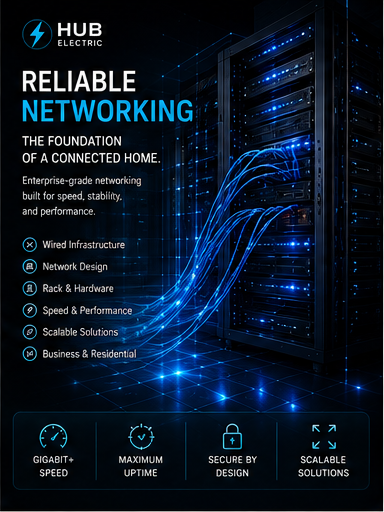
Ethernet runs to televisions, access points, cameras, controllers, offices and other fixed locations give the home a stable data backbone and preserve wireless capacity for mobile devices.
Cables terminate in a structured location where switching, routing and related hardware can be mounted, powered and serviced without hunting through closets or cabinets.
Spare capacity, sensible pathways and documentation make it easier to add cameras, access points, automation hardware or new rooms later without redesigning the entire network.
Professional integration is a sequence: design the infrastructure first, install it cleanly, then configure and test the finished system under real operating conditions.
The design begins with floor plans, construction materials, equipment locations, internet service entry and the expected mix of wired and wireless devices.
Category cabling is routed to appropriate locations and terminated into organized patching and device outlets. The equipment location is prepared for power, ventilation and service access.
Routing, switching and wireless components are configured, then links and coverage are verified. The goal is consistent performance throughout the property, not merely a speed test beside the router.
Most smart-home problems eventually look like device problems, but many are actually network problems. A strong network reduces dropouts, improves responsiveness, makes remote access more dependable and gives every other connected system a better foundation. It is one of the least visible parts of the home—and one of the most important.
DISCUSS YOUR PROJECT ↗